Introduction
You're ready to source products from India.
You've received a few quotations. The pricing looks competitive. The supplier seems responsive, and everything appears to be moving in the right direction.
But one question remains:
How do you know if you're dealing with the right supplier?
For many international buyers, this is the most important decision in the entire sourcing process. Choosing the right supplier can lead to a long-term business relationship, consistent product quality, and reliable deliveries. Choosing the wrong one can result in shipment delays, quality issues, financial losses, or unnecessary disputes.
The good news is that supplier verification doesn't have to be complicated.
With a structured approach, you can significantly reduce risk before placing your first order.
In this guide, we'll walk you through the practical steps used to evaluate an Indian export supplier—from verifying business credentials and checking documentation to assessing communication, production capability, and overall reliability.
Whether you're sourcing spices, agricultural products, industrial goods, or manufactured products, these principles can help you make more informed sourcing decisions.
Quick Summary
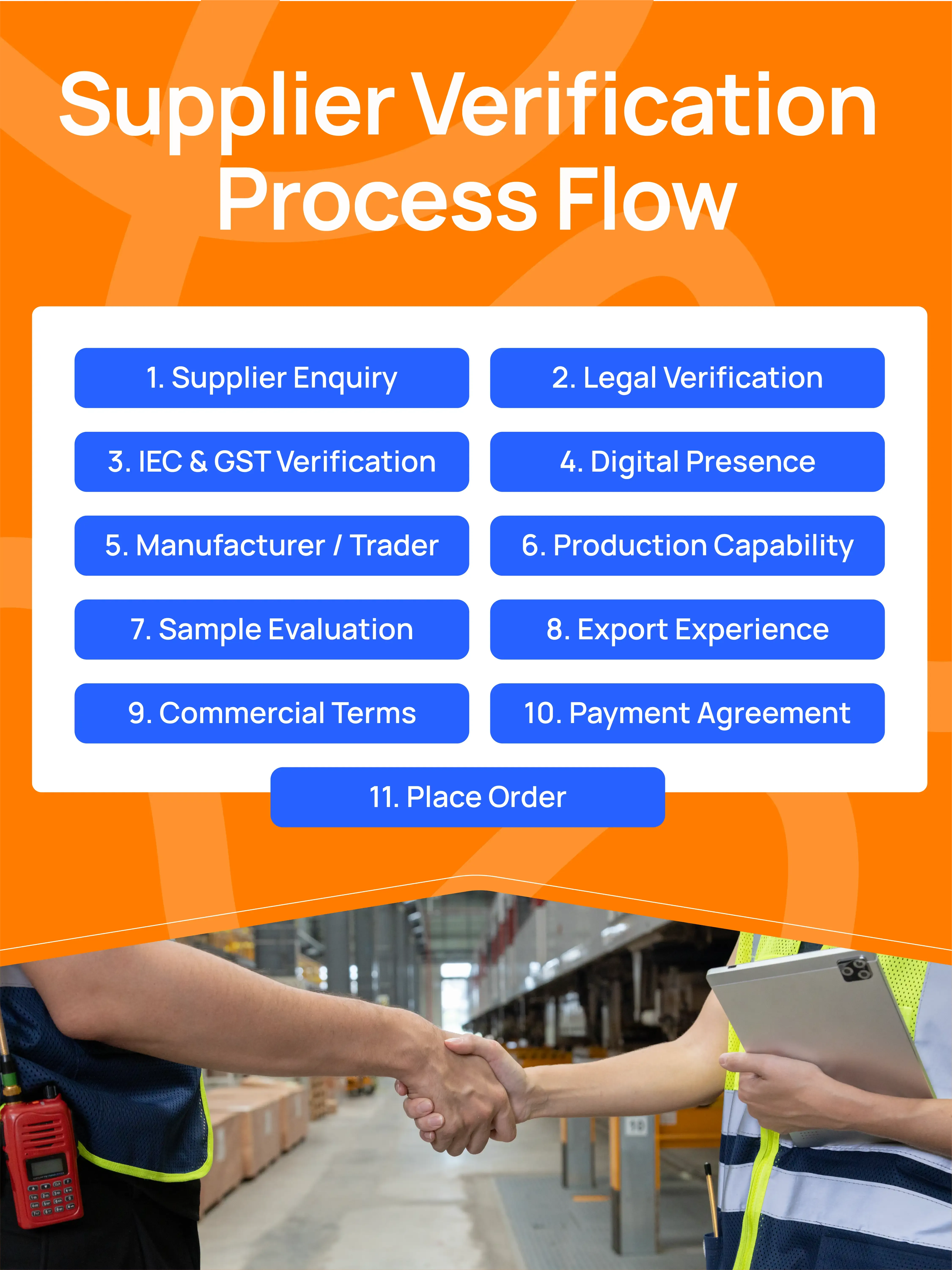
If you're short on time, here's what you should verify before placing your first order with an Indian export supplier:
- ✓ Verify the company's legal identity
- ✓ Check the IEC and GST registration
- ✓ Evaluate the supplier's digital presence
- ✓ Understand whether they are a manufacturer or trader
- ✓ Assess production capability
- ✓ Request and evaluate product samples
- ✓ Review export experience and certifications
- ✓ Evaluate communication quality
- ✓ Agree on commercial terms in writing
- ✓ Choose appropriate payment terms
The following sections explain each step in detail.
Why Supplier Verification Matters
International trade is built on trust.
Unlike domestic purchases, importing often involves large order values, longer lead times, international regulations, and limited opportunities to inspect products in person before production or shipment. That makes supplier selection one of the most critical decisions an importer can make.
A competitive quotation may look attractive, but price alone rarely tells the full story.
A reliable supplier should be able to deliver consistent product quality, provide accurate documentation, communicate clearly, and meet agreed timelines. These factors often have a greater impact on a successful business relationship than finding the lowest price.
Supplier verification is not about assuming every supplier is unreliable.
It's about carrying out reasonable due diligence before committing your time, money, and reputation to a business relationship.
Even experienced importers follow verification processes because they understand that preventing problems is far easier—and far less costly—than resolving them after an order has been placed.
The objective is simple:
Find a supplier who can consistently deliver what they promise, not just one who offers the lowest quotation.
The following steps will help you evaluate an Indian export supplier with greater confidence before placing your first order.
The process may seem detailed, but investing a few hours in verification before placing your first order can save weeks—or even months—of costly problems later.
Step 1: Verify the Legal Identity of the Business
The first step in supplier verification has nothing to do with pricing, product quality, or negotiations.
Before discussing commercial terms, confirm that the business legally exists and is authorised to operate.
A genuine supplier should be able to provide its business registration details without hesitation. Depending on the type of business, these documents may differ. For example, a company registered under the Companies Act will have different registration records than a sole proprietorship or partnership.
At a minimum, ask the supplier to share the business details relevant to their legal structure.
These may include:
Not every business will have every document listed below. The documents available depend on the supplier's legal structure and the nature of their business.
- Certificate of Incorporation (for companies)
- Partnership registration (if applicable)
- Proprietorship details (where applicable)
- Permanent Account Number (PAN)
- Goods and Services Tax (GST) registration, if applicable
- Import Export Code (IEC)
- Udyam Registration (for MSMEs, where applicable)
Receiving copies of these documents is only the first step.
The information should be consistent across all documents.
Verify that the company name, business address, authorised person, and other key details align wherever applicable. Any significant inconsistency doesn't automatically indicate wrongdoing, but it should be clarified before proceeding further.
Professional suppliers generally maintain organised business records and respond promptly to reasonable due diligence requests.
Tip: Keep a digital record of all documents received during supplier verification. It creates a clear audit trail and makes future procurement decisions easier.
Step 2: Verify the Import Export Code (IEC)
If a supplier claims to export products directly from India, one of the most important documents to verify is the Import Export Code (IEC).
The IEC is a ten-digit identification number issued by the Directorate General of Foreign Trade (DGFT), Government of India. In most cases, an IEC is required for businesses that import or export goods from India.
As an international buyer, verifying the IEC helps confirm that the supplier is registered to conduct import-export activities.
Don't rely solely on a scanned copy of the certificate.
Ask the supplier for their IEC number and verify it through the official DGFT portal.
Always use the official DGFT portal for verification rather than relying on screenshots or documents shared through messaging application
During verification, check that:
- ✓ The IEC is valid.
- ✓ The business name matches the supplier's documents.
- ✓ The registered details are consistent with the information you've already received.
Keep in mind that possessing a valid IEC does not guarantee product quality or business reliability.
It simply confirms one important part of the supplier's legal export credentials.
Think of it as an essential checkpoint—not the final decision.
Step 3: Verify the GST Registration
The next document to review is the Goods and Services Tax (GST) registration, where applicable.
A supplier registered under GST will have a unique GST Identification Number (GSTIN). Using the official GST portal, you can verify whether the registration is active and whether the information matches the supplier's business details.
Pay particular attention to:
- ✓ Legal business name
- ✓ Business address
- ✓ Registration status (Active or Cancelled)
- ✓ Type of business registration
Consistency matters.
If the quotation is issued by one business name while the GST registration belongs to another entity, ask for an explanation before moving forward.
There can be legitimate reasons for such differences—for example, businesses operating under a trade name while being legally registered under another name—but these situations should always be understood before placing an order.
Supplier verification is not about looking for reasons to reject a business.
It's about ensuring transparency before entering into a commercial relationship.
The more information you verify at the beginning, the lower the likelihood of misunderstandings later.
Step 4: Evaluate the Supplier's Digital Presence
A company's online presence should never be the sole basis for your decision, but it can provide useful insights when considered alongside official documents and direct communication.
Not every reliable exporter has a sophisticated website, especially small and medium-sized businesses. However, there should be reasonable consistency across the information they present online.
Start by reviewing:
- The company's official website (if available)
- LinkedIn company page
- Founder or key management LinkedIn profiles
- Google Business Profile (if available)
- Business directories or trade portals
- Company email address
As you review these sources, look for consistency rather than perfection.
Avoid judging a supplier solely by website design. Check whether the company name, address, contact details, products, and branding align across different platforms. If the supplier claims to have been exporting for many years, their online presence should generally support that claim.
One detail that is often overlooked is the email address.
While some smaller businesses may still communicate through Gmail or similar services, an established exporter usually communicates through an email address linked to its own domain (for example, name@company.com). This isn't a guarantee of credibility, but it is another indicator of professionalism.
Remember, digital presence should support your due diligence—not replace it.
Step 5: Understand Whether You're Buying from a Manufacturer or a Trader
One of the biggest misconceptions among first-time importers is that buying directly from a manufacturer is always the best option.
In reality, both manufacturers and trading companies can be excellent business partners.
The important point is understanding who you're dealing with.
A manufacturer produces the goods.
A trading company sources products from one or more manufacturers and manages procurement, quality coordination, logistics, or exports on behalf of buyers.
Many experienced importers intentionally work with sourcing companies because they value access to multiple suppliers, simplified communication, and local market knowledge.
Instead of asking, "Are you a manufacturer?", consider asking questions such as:
- Do you manufacture the products yourself?
- Which parts of the production process are handled in-house?
- Do you source from partner manufacturers?
- Who manages quality inspections?
- Who is responsible for export documentation?
- Can you support customised specifications or packaging?
There is no universally correct answer.
What matters is transparency.
A supplier who clearly explains their role in the supply chain is generally easier to work with than one who provides unclear or inconsistent answers.
Step 6: Assess Production Capability
Once you've established who you're dealing with, the next step is determining whether they can consistently fulfil your requirements.
This becomes increasingly important as order volumes grow.
Ask questions such as:
- What is your monthly production capacity?
- What is your typical lead time?
- Can production be scaled for larger orders?
- How do you maintain quality consistency?
- What packaging options do you offer?
- Have you supplied similar specifications before?
Where appropriate, request supporting information such as:
- ✓ Factory photographs
- ✓ Production videos
- ✓ Images of packaging facilities
- ✓ Warehouse photographs
- ✓ Machinery details
- ✓ Production process overview
If visiting the factory is practical, an on-site visit can provide valuable insights into production processes, cleanliness, inventory management, and overall operational standards. When an in-person visit isn't feasible, consider engaging an independent inspection agency before placing larger orders.
If your order volume is significant, consider arranging an independent factory audit or a third-party inspection before committing to a long-term supply agreement.
Production capability isn't just about having the right machinery.
It's about whether the supplier can consistently deliver the agreed product quality, quantity, packaging, and timeline over multiple orders.
Many supplier relationships don't fail because of product quality—they fail because the supplier cannot consistently meet demand as business grows.
Choosing a supplier who can scale with your business can save considerable time and effort in the future.
Practical Tip
As you evaluate different suppliers, don't rely on memory alone.
Create a simple comparison sheet where you record key details for each supplier, including:
- ✓ Legal business name
- ✓ Location
- ✓ Manufacturer or trader
- ✓ Products offered
- ✓ Production capacity
- ✓ Certifications
- ✓ Lead time
- ✓ Payment terms
- ✓ Communication quality
- ✓ Overall assessment
Comparing suppliers side by side often reveals strengths and weaknesses that may not be obvious when evaluating them individually.
Step 7: Request Samples and Evaluate Them Carefully
No matter how professional a supplier appears on paper, avoid placing a large order without first evaluating a product sample whenever it is practical and commercially feasible.
A sample gives you the opportunity to verify whether the supplier can deliver the quality and specifications they have promised.
However, receiving a sample is only the beginning. The real value lies in evaluating it systematically.
Depending on the product, consider checking:
- ✓ Overall product quality
- ✓ Dimensions, size, or grade (where applicable)
- ✓ Colour and appearance
- ✓ Packaging quality
- ✓ Labelling and markings
- ✓ Weight and consistency
- ✓ Finish and workmanship
- ✓ Any specifications agreed during discussions
For agricultural products such as spices, coffee, or herbs, buyers may also evaluate characteristics such as cleanliness, moisture, aroma, colour, size, and uniformity. Depending on the destination market and product requirements, laboratory testing may also be appropriate before proceeding with larger orders.
If possible, compare the sample against your written product specifications rather than relying solely on visual inspection.
Keep an approved sample as a reference for future shipments. It can help both buyer and supplier maintain consistency across repeat orders.
Remember, the objective isn't simply to determine whether the sample looks good.
It's to determine whether the supplier can consistently reproduce the same quality across every shipment.
Consistency is often more valuable than perfection.
Step 8: Evaluate the Supplier's Export Experience
Exporting involves far more than manufacturing a product.
Documentation, packaging, compliance, logistics, customs procedures, and communication all play a significant role in ensuring goods reach the buyer smoothly.
This is why understanding a supplier's export experience is an important part of your evaluation.
Some useful questions include:
- Which countries do you currently export to?
- Have you supplied this product to my market before?
- Which ports do you typically ship from?
- Can you provide the documentation required for my destination country?
- How do you manage export documentation and shipping coordination?
- What is your typical production and dispatch timeline?
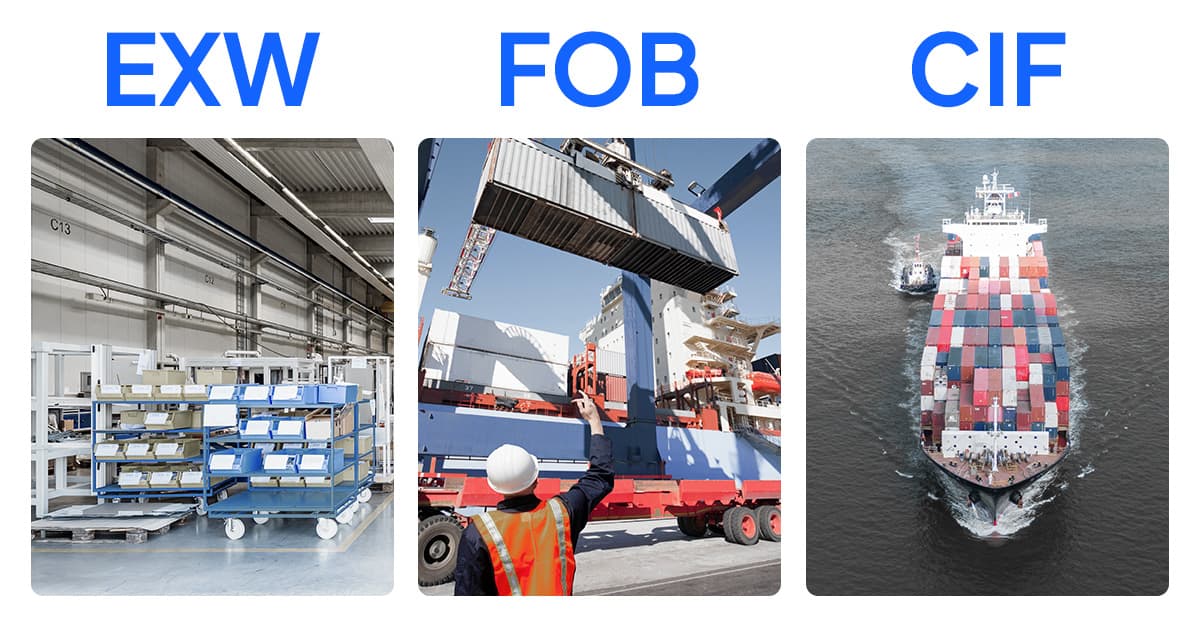
- Have you handled shipments under my preferred Incoterm (FOB, CIF, EXW, etc.)?
Previous export experience does not automatically guarantee future performance.
However, suppliers who regularly export to your region may already be familiar with documentation requirements, packaging expectations, and regulatory standards relevant to your market.
If a supplier has limited export experience, that doesn't necessarily make them unsuitable.
Many businesses begin exporting for the first time every year.
In such cases, it's even more important to assess their willingness to communicate, learn, and coordinate effectively throughout the process.
Step 9: Review Relevant Certifications and Compliance Requirements
One common misconception is that every exporter should hold the same certifications.
In reality, certification requirements vary depending on the product, industry, and destination country.
Instead of asking whether a supplier is "certified," determine which certifications or compliance documents are actually relevant to your purchase.
Examples may include:
- Food safety certifications
- Quality management certifications
- Organic certifications (where applicable)
- Product-specific compliance documents
- Laboratory test reports
- Certificates required by the importing country
Ask the supplier to explain which certifications they hold and why they are relevant to your order.
Where possible, verify certificates with the issuing organisation or certification body rather than relying solely on scanned copies.
More importantly, remember that certifications support supplier evaluation—they do not replace it.
A certified supplier should still be assessed for communication, consistency, production capability, and overall reliability.
Think of certifications as one piece of the larger due diligence process, not the final proof of supplier quality.
Step 10: Pay Attention to Communication
Communication is one of the simplest indicators of how a supplier may perform after you place an order.
During the quotation stage, observe not only how quickly the supplier responds, but also the quality of their communication.
Ask yourself:
- Are my questions answered clearly?
- Do they provide complete information?
- Are commitments followed through?
- Do they communicate proactively if there is a delay?
- Are quotations and documents well organised?
- Do they ask relevant questions to understand my requirements?
Strong communication is often a sign of organised internal processes.
Likewise, inconsistent communication before an order may indicate challenges after production begins.
Observe how the supplier handles unexpected situations. A delayed reply isn't necessarily a concern. However, failing to communicate delays or avoiding difficult conversations may indicate future operational challenges.
International trade involves multiple stages, changing timelines, documentation requirements, and coordination between different parties.
Working with a supplier who communicates clearly and professionally can help prevent misunderstandings long before goods are shipped.
Ultimately, supplier verification is not about finding a perfect company.
It's about finding a business partner who is transparent, reliable, and committed to meeting agreed expectations.
Procurement Insight
Experienced buyers rarely make decisions based on a single factor.
Instead, they consider the complete picture:
- ✓ Legal compliance
- ✓ Business transparency
- ✓ Production capability
- ✓ Product quality
- ✓ Export experience
- ✓ Communication
- ✓ Long-term reliability
A supplier who scores well across all these areas is often a stronger long-term partner than one who excels in only one or two.
Supplier Evaluation Scoring Matrix
Evaluate suppliers across key areas to make confident sourcing decisions. Click the stars to rate!
Scores ≥ 80 indicate a reliable partner. Scores between 60-79 suggest proceeding with caution. Scores < 60 indicate high risk.
Step 11: Understand the Commercial Terms Before You Commit
Even after verifying a supplier's credentials, production capability, and product quality, one important area remains—commercial terms.
Many disputes in international trade arise not because of poor products, but because expectations were never clearly agreed upon.
Before confirming an order, ensure both parties have a common understanding of key commercial terms, including:
- ✓ Product specifications
- ✓ Quantity
- ✓ Unit price
- ✓ Minimum Order Quantity (MOQ)
- ✓ Payment terms
- ✓ Delivery timeline
- ✓ Packaging requirements
- ✓ Shipping terms (Incoterms)
- ✓ Inspection requirements
- ✓ Responsibility for documentation
Where possible, document these terms in writing before production begins.
Ensure both parties clearly understand the agreed Incoterm, as it determines responsibilities for transportation, insurance, risk transfer, and shipping costs.
Avoid relying solely on verbal discussions or messaging applications for important commercial agreements.
Clear documentation reduces misunderstandings and provides both parties with a common point of reference throughout the transaction.
Step 12: Choose a Payment Method That Matches the Level of Trust
Payment terms are often one of the most sensitive aspects of international trade.
The appropriate payment method depends on several factors, including the order value, the level of trust between buyer and supplier, and the commercial practices of both businesses.
Common payment arrangements may include:
- ✓ Advance payment
- ✓ Partial advance with balance before shipment
- ✓ Documentary collections
- ✓ Letters of Credit (L/C)
- ✓ Other mutually agreed commercial payment terms
There is no single payment method that is suitable for every transaction.
For first-time business relationships, buyers often seek arrangements that balance commercial practicality with risk management.
As trust develops over multiple successful shipments, payment terms may evolve based on mutual confidence and business requirements.
Never allow urgency alone to dictate payment decisions. Legitimate business transactions should provide reasonable time for due diligence before funds are transferred.
If you are unfamiliar with international payment methods, consult your bank or a qualified trade professional before finalising payment arrangements.
Common Red Flags to Watch For
Not every issue indicates fraud.
However, certain warning signs deserve additional attention before placing an order.
Consider carrying out further due diligence if you notice situations such as:
- The supplier is unwilling to share basic business documents.
- Business information is inconsistent across different documents.
- The company avoids answering straightforward questions.
- Product specifications change frequently without explanation.
- Pricing appears significantly lower than the prevailing market without a reasonable explanation.
- Communication becomes inconsistent after commercial discussions begin.
- The supplier pressures you to make immediate payment without allowing reasonable verification.
- Important commitments are made verbally but never confirmed in writing.
- The supplier refuses to provide product samples where commercially reasonable.
- Frequent changes in bank account details without a clear explanation.
- Reluctance to provide references or answer reasonable due diligence questions.
A single red flag does not necessarily mean you should reject a supplier.
Instead, treat it as a signal to ask more questions and seek additional clarification before proceeding.
Good supplier relationships are built on transparency, not assumptions.
Supplier Verification Checklist
Before placing your first order, confirm that you have completed the following:
Completing this checklist cannot eliminate every business risk.
However, it can significantly improve your ability to make informed sourcing decisions.
Frequently Asked Questions
No. An IEC confirms that a business is registered for import-export activities, but it does not guarantee product quality, production capability, or commercial reliability. It should be considered one part of a broader supplier verification process.
Not necessarily.
Many international buyers work successfully with trading companies and sourcing partners because they provide access to multiple manufacturers, local market knowledge, and procurement support.
The important factor is understanding the supplier's role and ensuring they are transparent about it.
Not always.
A lower price may be attractive, but factors such as consistent quality, communication, documentation, production capability, and delivery reliability often have a greater impact on long-term business success.
Whenever practical, yes.
A sample allows you to evaluate whether the supplier can meet your quality expectations before committing to a larger purchase.
No.
Certifications provide useful information, but they should complement—not replace—your overall due diligence.
The time required depends on the complexity of the order and the information available. For a first-time supplier, the verification process may take anywhere from a few days to a couple of weeks.
Investing this time upfront can help prevent costly issues later in the sourcing process.
Yes. Many aspects of supplier verification—including reviewing business documents, checking government registrations, evaluating digital presence, requesting samples, and conducting video meetings—can be completed remotely.
For larger or long-term orders, an independent third-party inspection or factory audit may provide additional assurance if an in-person visit is not practical.
It depends on the value, complexity, and risk associated with your order.
For larger orders or when working with a new supplier, an independent inspection agency can provide an objective assessment of product quality, production status, or factory capability before shipment.
Not necessarily. GST registration requirements depend on the nature of the business and applicable Indian tax regulations.
However, if a supplier provides a GST Identification Number (GSTIN), you should verify its status through the official GST portal.
Not every inconsistency indicates a problem. Start by asking the supplier for clarification and supporting documentation. Many differences have legitimate explanations, such as changes in business address or operating under a registered trade name.
If important inconsistencies remain unresolved, consider conducting additional due diligence or evaluating alternative suppliers before placing an order.
Useful Official Resources
| Resource | Purpose |
|---|---|
| DGFT | Verify IEC |
| GST Portal | Verify GST |
| Udyam Portal | MSME verification |
| APEDA | Agriculture exports |
| Spice Board of India | Spice exports |
| FIEO | Export guidance |
Supplier Verification Is an Ongoing Process
Supplier verification shouldn't end after the first shipment.
As your business relationship develops, continue monitoring product quality, communication, delivery performance, documentation accuracy, and consistency across future orders.
Long-term sourcing success is built through continuous evaluation rather than a one-time assessment.
Conclusion
Choosing the right export supplier is about far more than comparing quotations.
It is about building a relationship with a business that can consistently deliver on its commitments.
By taking the time to verify legal credentials, assess production capability, review documentation, evaluate communication, and understand commercial terms, buyers can significantly reduce risk and build stronger long-term partnerships.
Supplier verification is not a one-time task.
It is an ongoing process that supports better sourcing decisions as your business grows.
Strong supplier relationships are built on transparency, consistency, and mutual trust—not simply on competitive pricing.
At Grambu Global Exports, we believe successful exports begin long before goods are shipped. They begin with careful supplier selection, transparent communication, and disciplined execution.
Whether you're sourcing spices, agricultural products, or other products from India, investing time in supplier verification today can help build more reliable business relationships tomorrow
Downloadable Supplier Verification Checklist (Coming Soon)
We're preparing a printable Supplier Verification Checklist to help international buyers evaluate suppliers more efficiently. It will be available here soon.
Disclaimer : This guide is intended for informational purposes and should not be considered legal, financial, or tax advice. Import regulations and documentation requirements may vary depending on the destination country and the products being sourced. Buyers should consult the relevant authorities or qualified professionals where necessary.