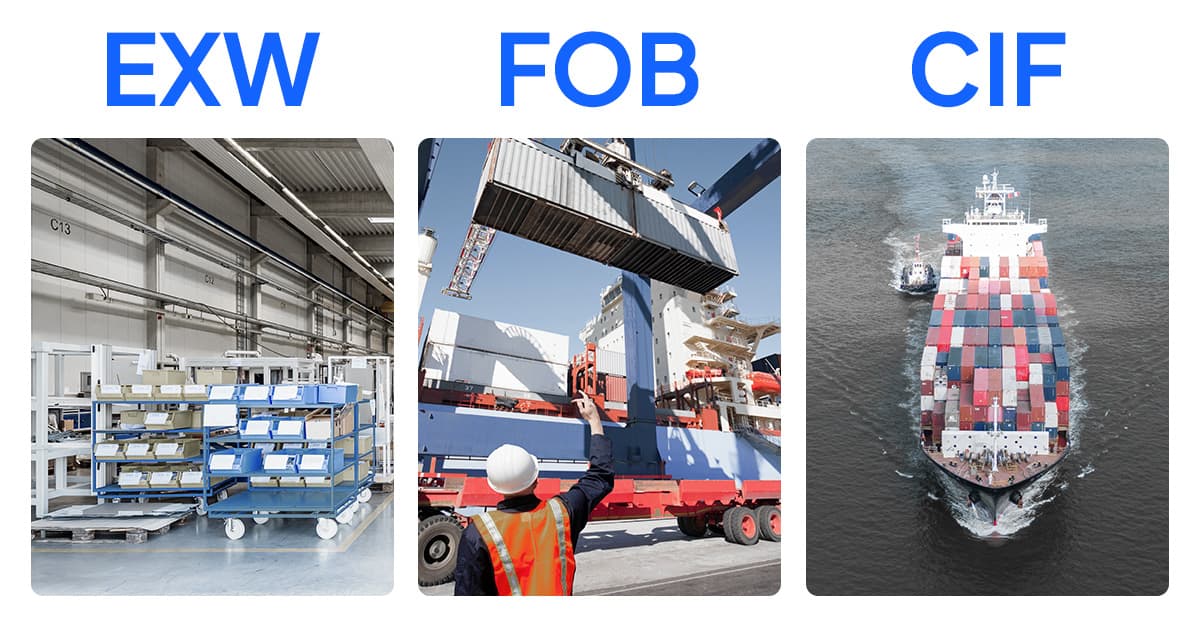
Introduction - FOB vs CIF vs EXW: Why the Shipping Term Can Change Your Real Import Cost
A supplier's product price is only one part of your import cost.
The shipping term attached to that price can determine who pays for inland movement, export clearance, main transportation, insurance and other parts of the delivery process.
That means a quotation of $5,000 EXW and a quotation of $5,300 FOB cannot be compared simply by looking at the two numbers.
The buyer's responsibilities are different.
And so is the point at which costs and risks move from the seller to the buyer.
This becomes particularly important when sourcing agricultural products and spices from India. A supplier may be located close to a production region, while the cargo may ultimately move through a major port such as Cochin, Mundra, Nhava Sheva or Chennai.
For an international procurement team, the question is therefore not simply:
It is:
That is where EXW, FOB and CIF become commercially important.
In this guide, we'll break down the three terms, compare their cost and risk allocation, and look at how an importer can decide which structure makes sense for a particular shipment.
What Are Incoterms?
Incoterms® are standardised trade terms published by the International Chamber of Commerce (ICC).
They establish important responsibilities between the seller and buyer in a sale of goods, including aspects of delivery, transportation, costs, risk and certain customs formalities. The current edition is Incoterms® 2020, which contains 11 rules.
Think of an Incoterm as a framework for answering three practical questions:
Who is responsible for what?
- Who arranges the transportation?
- Who handles export clearance?
- Who arranges insurance where applicable?
Who pays for what?
- Which costs are included in the seller's price?
- Which costs remain with the buyer?
When does risk transfer?
- If the cargo is damaged or lost during transportation, at what point does the risk move from seller to buyer?
This third question is particularly important because the party paying for a particular transportation leg is not necessarily the party carrying the risk for that entire journey.
CIF is a good example of this distinction, which we'll examine later.
Incoterms Are Not the Same as a Freight Quotation
This distinction is worth remembering.
If a supplier writes:
the Incoterm tells you how certain responsibilities and risks are allocated under the agreed rule. It does not mean that every cost associated with getting the cargo from the supplier's facility to your warehouse in Europe is included.
Destination customs clearance, duties, taxes, inland delivery and other charges may remain outside the seller's obligation depending on the contract and applicable requirements.
So when comparing quotations, don't compare: Product price alone. Compare the complete commercial structure.
A useful way to think about it
- ✓ Seller makes goods available.
- ✓ Buyer takes over most of the journey.
- ✓ Seller handles the shipment up to loading on board.
- ✓ Buyer takes over the main carriage and subsequent journey.
- ✓ Seller arranges carriage and insurance to the named destination port.
- ✓ Buyer still assumes risk once the goods are on board, while destination-side responsibilities remain to be examined.
The exact allocation must always be read against the applicable Incoterms® 2020 rule and the named place/port in the contract. ICC Incoterms® 2020
A note for containerised shipments
FOB is widely used in international trade, but buyers should not automatically assume it is the most appropriate rule for every container shipment.
Under Incoterms® 2020, FOB is designed for sea or inland-waterway transport where the goods are delivered on board the vessel. When goods are handed over to a carrier at a container terminal before loading, FCA may be more appropriate.
For containerised spice shipments, the choice should therefore be made based on how and where the cargo is actually handed over-not simply because "FOB" is the familiar term.
EXW — Ex Works Explained
Under EXW (Ex Works), the seller makes the goods available at the agreed location, typically the factory or warehouse. From there, the buyer takes responsibility for arranging the remaining movement under the rule.
For an Indian spice shipment, that can mean:
A quotation of $5.00/kg EXW therefore cannot be directly compared with $5.30/kg FOB. The EXW buyer still has additional origin-side costs and responsibilities to account for.
This becomes particularly relevant when the supplier is located in an agricultural region such as Idukki, Kerala or Guntur, Andhra Pradesh, while the buyer is managing the shipment from overseas.
When does EXW make sense?
EXW can work well when the buyer:
- ✓ Has an established logistics partner in India.
- ✓ Can efficiently manage origin-side transportation and formalities.
- ✓ Wants greater control over the logistics chain.
- ✓ Has local representation to coordinate the shipment.
EXW is therefore not a bad option. It simply places more responsibility on the buyer.
The question worth asking
Instead of asking only:
ask:
The objective is to compare equivalent costs, not simply the lowest product quotation.
FOB — Free on Board Explained
FOB: A Practical Balance Between Origin Control and Freight Control
FOB (Free on Board) creates a clearer division of responsibility between seller and buyer.
For a typical sea shipment, the seller handles the origin-side process and delivers the goods on board the vessel at the named port. The buyer then takes responsibility for the main carriage and the journey that follows.
For an Indian spice shipment, the seller's side generally involves:
The buyer then controls:
This structure can be attractive to buyers who already have freight-forwarding relationships or negotiated ocean freight rates.
Why Buyers Often Prefer FOB
Consider a buyer importing 20 MT of cardamom from Kerala.
If the buyer already works with a freight forwarder, they may prefer to:
- ✓ Control the shipping line or forwarder.
- ✓ Negotiate the ocean freight independently.
- ✓ Understand their destination costs directly.
- ✓ Keep better visibility over the main transportation component.
Meanwhile, the Indian supplier manages the local execution that requires knowledge of the origin market.
That can create a practical middle ground:
For many bulk sourcing transactions, that separation is commercially useful.
But One Detail Matters
FOB is specifically a sea and inland-waterway rule, where delivery occurs when the goods are placed on board the vessel.
For containerised cargo that is handed over to a carrier at a terminal before loading, FCA may sometimes be the more appropriate Incoterm under Incoterms® 2020.
So don't select FOB simply because it is the most familiar term.
Look at where and how the cargo is actually handed over.
When FOB can make sense
FOB can be attractive when the buyer:
- ✓ Has its own freight-forwarding arrangements.
- ✓ Wants control over ocean freight.
- ✓ Wants the exporter to manage Indian origin-side logistics.
- ✓ Needs clearer separation between product cost and international freight.
CIF — Cost, Insurance & Freight Explained
CIF: More Freight Convenience, Not Complete Delivery
Under CIF (Cost, Insurance and Freight), the seller arranges and pays for the main ocean freight and the required insurance to the named destination port.
For an Indian spice shipment, the structure broadly looks like:
This can make CIF attractive when the buyer prefers the supplier to coordinate the main international freight rather than managing it independently.
But there is one distinction that procurement teams should never overlook:
Under CIF, risk transfers to the buyer when the goods are loaded on board the vessel at the shipment port.
That means cost and risk transfer at different points.
What CIF Can Simplify
CIF may be useful when the buyer:
- ✓ Does not have preferred ocean-freight contracts.
- ✓ Wants the supplier to coordinate the main carriage.
- ✓ Prefers a single origin-to-destination-port quotation.
- ✓ Wants the seller to arrange the required insurance.
For example:
can make supplier comparison simpler because the main ocean freight is already incorporated into the quotation.
But CIF is not the same as landed cost.
Destination customs clearance, duties, taxes, inland transportation and other destination-side charges may still remain with the buyer, depending on the transaction.
The Question to Ask
Before accepting a CIF quotation, ask:
Clarify the named destination port, insurance coverage, destination charges and import responsibilities before comparing quotations.
FOB vs CIF vs EXW — Side-by-Side Comparison
At this point, the differences are easier to see when the three terms are placed next to each other.
The key difference
If you remember only one thing from this comparison, make it this:
That is particularly important under CIF, where the seller pays for freight to the named destination port, but risk transfers when the goods are loaded on board the vessel.
And the quotation itself still needs to be read alongside the named place or port and the agreed Incoterms® 2020 rule.
One more practical point
Don't compare an EXW price against a CIF price and decide which supplier is cheaper.
First bring the quotations to a comparable cost basis.
That is where the next section becomes useful: we'll take a practical Indian spice shipment and see how the cost responsibility changes under EXW, FOB and CIF.
A Practical Indian Spice Import Example
Let's make the difference concrete.
Imagine a buyer is sourcing 20 MT of Indian black pepper for delivery to Europe.
The supplier offers three commercial structures:
At first glance, EXW looks cheapest.
But that conclusion is premature.
The EXW buyer still has to account for the costs and responsibilities between the supplier's premises and the point where the international shipment is handed over.
The FOB quotation is higher, but part of that difference represents origin-side execution already handled by the seller.
The CIF quotation is higher again because the seller has also arranged the main ocean freight and insurance required under the CIF rule.
The right comparison
Instead of asking:
ask:
This is especially important when comparing suppliers from different regions of India.
A supplier located closer to a suitable export gateway may have a higher factory price but a lower overall logistics cost.
Likewise, a supplier offering an attractive EXW price from a remote production area may require additional inland coordination that changes the economics.
One important limitation
The numbers above are illustrative, not current market quotations.
Actual costs will depend on the product, quantity, origin location, port, shipping line, freight market, destination and contract.
The purpose of the example is simply to show why Incoterms should be evaluated as a complete cost-and-responsibility structure rather than as three letters attached to a price.
Which Shipping Term Should You Choose?
There is no single Incoterm that is best for every shipment.
The right choice depends on how much control the buyer wants, what logistics capabilities they already have, and where they want the seller's responsibility to end.
Use EXW when:
- You have reliable logistics support in India.
- You can manage origin-side transportation and export formalities.
- You want maximum control over the logistics chain.
Consider FOB when:
- You have your own freight forwarder or negotiated ocean freight.
- You want the supplier to manage inland movement and export clearance.
- You want greater control over the main freight component.
For many bulk shipments of Indian spices, this can be a practical structure—but the specific cargo handover should still be checked against the Incoterms® rule being used.
Consider CIF when:
- You prefer the supplier to arrange the main ocean freight.
- You don't have a preferred freight arrangement.
- You want a simpler quotation up to the named destination port.
But don't treat CIF as a landed-cost quotation. Destination charges, import clearance, duties, taxes and inland delivery may still be yours.
A Simple Decision Framework
This is a starting framework, not a universal rule.
The product, origin, destination, container arrangement, freight contract and actual handover point can all change the decision.
The question I would ask before choosing
Don't ask:
Ask:
That is the more useful procurement question.
EU, GCC & Africa: Practical Considerations
The Incoterm is only one part of an international shipment.
The destination market also affects documentation, compliance, testing, port procedures and the practical cost of getting the cargo released.
For buyers sourcing Indian spices and agricultural products, these considerations should be addressed before the quotation is finalised, not after the cargo has left India.
European Union Buyers
For EU-bound food products, product compliance is as important as logistics.
Depending on the product and destination requirements, buyers may need to consider controls relating to:
- ✓ Pesticide residues
- ✓ Mycotoxins
- ✓ Heavy metals
- ✓ Microbiological parameters
- ✓ Product documentation
- ✓ Traceability
- ✓ Labelling requirements
A shipment entering through a major gateway such as Rotterdam or Hamburg still needs to satisfy the applicable EU import and food-safety requirements.
The important point is:
The Incoterm determines commercial responsibilities under the agreed rule; it does not replace the importer's regulatory obligations.
For higher-control products or markets, it is sensible to agree on testing requirements and documentation before production or shipment.
GCC Buyers
For GCC importers, India's geographical position can provide practical shipping options, particularly through ports on India's west coast.
Depending on the destination, cargo may have relatively direct maritime connections from Indian ports.
For buyers choosing between FOB and CIF, the same question applies:
If you have established freight relationships, FOB can provide greater control.
If supplier-arranged freight is more convenient, CIF may simplify the main-carriage arrangement.
But freight should still be evaluated against the actual destination costs and service terms, rather than simply the headline quotation.
African Union Buyers
For African markets, predictability of the complete logistics chain can be particularly important.
Before accepting a CIF quotation, clarify:
- ✓ Named destination port
- ✓ Freight inclusion
- ✓ Insurance coverage
- ✓ Destination terminal or handling charges
- ✓ Import clearance responsibility
- ✓ Local delivery
- ✓ Any agent or service charges outside the seller's obligation
A quotation can look straightforward while leaving several destination-side costs with the buyer.
The objective is therefore the same:
One Rule for Every Market
Whether the shipment is going to Rotterdam, Dubai or an African port, don't make the Incoterm decision in isolation.
Look at three things together:
↓
Incoterm & logistics structure
↓
Destination compliance & landed cost
That gives the procurement team a much clearer picture of the actual transaction.
Regulatory requirements vary by product and destination. Buyers should verify the current requirements applicable to their specific shipment before import.
Buyer Checklist Before Accepting a Quotation
Before accepting a quotation, I would not look at the price alone.
I would first make sure both sides are pricing and accepting the same commercial structure.
Product
Incoterm
Origin Costs
Freight & Insurance
Destination
Final Cost
Before comparing two suppliers, calculate:
Calculate Comparable Import Cost
Import Cost$0.00
The exact calculation will depend on the transaction, but the principle is straightforward:
Don't compare two quotations until you know what each quotation actually includes.
One Question Worth Asking Your Supplier
Before confirming the order, ask:
A good quotation should make the commercial structure easier to understand—not harder.
And if something is unclear, clarify it before the purchase order or contract is finalised.
The goal isn't to choose EXW, FOB or CIF.
The goal is to choose the structure that gives your company the right balance of cost, control, risk and operational responsibility for that particular shipment.
Final Takeaway
There is no universally "best" shipping term.
EXW, FOB and CIF simply distribute cost, responsibility and risk differently.
For an importer sourcing Indian spices, the right choice depends on the structure behind the shipment.
- EXW — more origin-side responsibility for the buyer, but greater control.
- FOB — the exporter manages the Indian origin-side process while the buyer controls the main freight.
- CIF — the exporter arranges the main freight and insurance to the named destination port, while the buyer still needs to understand the risk-transfer point and destination costs.
The important lesson is simple:
Before confirming a purchase, make sure you understand what the price includes, what it excludes, where risk transfers, and who is responsible for each stage of the shipment.
That clarity is worth more than a small difference in the initial quotation.
Planning to Import from India?
If you're currently comparing suppliers for Indian spices, agricultural products or commodities, you don't need to start with a complicated conversation.
Send us four things:
We'll help you understand the sourcing requirement and coordinate with the relevant supplier and logistics parties in India.
At Grambu Global Exports, our role is straightforward: make the Indian side of your sourcing process clearer and easier to manage.
- Email: hello@grambu.com
- Website: grambu.com
Request a sourcing discussion Share your requirement with our team.
Sources & Further Reading
- ✓ International Chamber of Commerce — Incoterms® Rules
- ✓ European Commission — Food Safety & Import Controls
- ✓ Directorate General of Foreign Trade (DGFT)
- ✓ Indian Customs Electronic Data Interchange Gateway (ICEGATE)
- ✓ Indian Trade Portal
- ✓ Department of Commerce, Government of India
Disclaimer: This article is intended as a practical procurement guide. Incoterm selection should be confirmed against the specific transaction, contract, product and destination requirements.
Frequently Asked Questions
Not necessarily. EXW may show a lower product price, but the buyer takes on additional origin-side responsibilities and costs. Compare the complete cost structure before deciding.
Neither is universally better. FOB can suit buyers who already control ocean freight, while CIF can be convenient when the buyer wants the seller to arrange the main carriage.
Under FOB, the buyer arranges and pays for the main carriage after delivery on board at the named port, while the seller handles the applicable origin-side obligations under the rule.
Under CIF, the seller arranges and pays for the main carriage to the named destination port and arranges the required insurance under the rule.
No. Under CIF, risk transfers when the goods are delivered on board the vessel at the shipment port, even though the seller pays for freight to the named destination port.
Yes, where commercially and operationally appropriate. It can work particularly well when the buyer has reliable logistics and export support in India.
FOB is specifically a sea/inland-waterway rule involving delivery on board the vessel. For containerised cargo handed to a carrier at a terminal before loading, FCA may sometimes be more appropriate. The actual handover arrangement should be checked against the applicable Incoterms® rule.
Generally, no. CIF covers cost, insurance and freight to the named destination port under the rule. Import clearance, duties, taxes and subsequent inland delivery can remain the buyer's responsibility.
Don't compare the headline product price alone. Compare: Product specification + Incoterm + origin costs + freight + insurance + destination costs + compliance requirements. That gives you a much more meaningful commercial comparison.